Nepal's drinking water landscape is at a crossroads. On one side, growing urban populations in Kathmandu Valley place enormous pressure on ageing pipe infrastructure. On the other, a growing range of water products — from unbranded refilling stations to internationally certified jar water suppliers — compete for the household and corporate market. For consumers, the choices can be confusing and the stakes are high: unsafe drinking water is directly linked to typhoid, hepatitis A, cholera, and chronic kidney disease, all of which remain significant health burdens in Nepal.
This guide explains what genuinely safe drinking water looks like, how to evaluate a water supplier, and why quality certification should be the non-negotiable starting point for any water purchasing decision.
The Reality of Drinking Water Safety in Kathmandu
According to the Nepal Water Supply Corporation's own quality monitoring reports, Kathmandu's municipal tap water regularly fails to meet WHO standards for drinking water. Key contaminants identified across multiple independent studies include:
- Coliform bacteria (including E. coli) — present in 60–70% of tested piped water samples, indicating faecal contamination pathways
- Arsenic — found at elevated levels in groundwater in parts of the Terai and increasingly in peri-urban Kathmandu wells
- Iron and manganese — leaches from ageing iron pipes; causes taste, odour, and staining issues and poses health risks at elevated concentrations
- Turbidity — particularly high during monsoon season (June–September) when rainwater infiltrates distribution networks
- Residual chlorine variability — chlorination is inconsistent across Kathmandu's distribution zones, leaving some areas under-dosed and vulnerable
Even households with household water filters face limitations. Most point-of-use ceramic or carbon filters remove bacteria and some heavy metals but do not address dissolved solids, viruses, or pharmaceutical residues. Without regular maintenance and cartridge replacement, filters can become breeding grounds for bacteria rather than removing them.
What to Look for in a Quality Drinking Water Supplier
Not all bottled or jar water in Nepal is equally safe. The market includes a wide spectrum — from properly certified suppliers with multi-stage purification to unbranded refilling stations that may use little more than basic filtration. Here is what to verify before choosing a water supplier:
1. DFTQC Registration and Licensing
The Department of Food Technology and Quality Control (DFTQC) under Nepal's Ministry of Agriculture and Livestock Development is the national authority for food and beverage safety. Any water sold for drinking in Nepal must be registered with and approved by the DFTQC. Ask your supplier for their DFTQC license number — reputable suppliers display it prominently.
2. ISO 22000:2018 Certification
ISO 22000 is the international standard for food safety management systems. It covers hazard analysis, process controls, and traceability throughout the entire supply chain — from water source to delivery. ISO 22000:2018 (the current version) is significantly more rigorous than earlier versions and requires annual third-party audits. A supplier holding this certification has demonstrated that their purification process, packaging, and delivery chain meet international food safety benchmarks.
3. Multi-Stage Purification Process
Effective drinking water purification requires multiple sequential stages, each addressing different categories of contaminants. A complete process should include:
- Sediment pre-filtration — removes suspended particles, sand, and rust
- Activated carbon filtration — removes chlorine, organic compounds, and taste/odour issues
- Reverse osmosis (RO) — removes up to 99% of dissolved solids, heavy metals, bacteria, and viruses
- Ultraviolet (UV) sterilisation — destroys any remaining microorganisms
- Ozonation — eliminates residual bacteria and viruses and extends shelf life without chemical preservatives
Suppliers using fewer than these five stages are unlikely to produce water that consistently meets WHO standards.
4. Hygienic Jar Washing and Handling
The jar is as important as the water inside it. A 20-litre polycarbonate jar that is returned, refilled, and redelivered can become a contamination source if not properly cleaned between uses. Ask your supplier about their jar washing process: it should include high-temperature washing, internal brushing, UV exposure, and ozone rinsing before refilling.
5. Regular Independent Water Testing
Certified suppliers test their water regularly — both in-house and via accredited independent laboratories — and can provide test certificates on request. Testing should cover microbiological parameters (total coliforms, E. coli, fecal coliforms), physical parameters (turbidity, pH, TDS), and chemical parameters (heavy metals, nitrates, residual ozone).
Aqua World's Approach to Quality and Safety
At Aqua World Pvt. Ltd., we have been providing certified drinking water to households and businesses across Kathmandu Valley since 2010. Our commitment to quality is not marketing language — it is backed by:
- ISO 22000:2018 certification — audited annually by an accredited third-party body
- DFTQC registration — fully licensed under Nepal's national food safety regulations
- 7-stage purification process — including sediment filtration, activated carbon, RO, UV sterilisation, and hyper-ozonation
- Automated jar washing facility — industrial-grade cleaning and sanitisation of all returned jars before refilling
- Regular water testing — microbiological and chemical tests conducted monthly, certificates available on request
Eco-Friendly and Sustainable Packaging
Aqua World is committed to reducing environmental impact. Our 20-litre polycarbonate jars are reusable, BPA-free, and designed for hundreds of refill cycles before replacement — dramatically reducing plastic waste compared to single-use 1.5-litre bottle formats. Our delivery vehicles are routed to minimise fuel consumption and carbon emissions across our Kathmandu, Lalitpur, and Bhaktapur service areas.
Convenient Delivery and Ordering
We understand that carrying heavy water jars from a shop is inconvenient. Aqua World offers flexible delivery options for households and businesses:
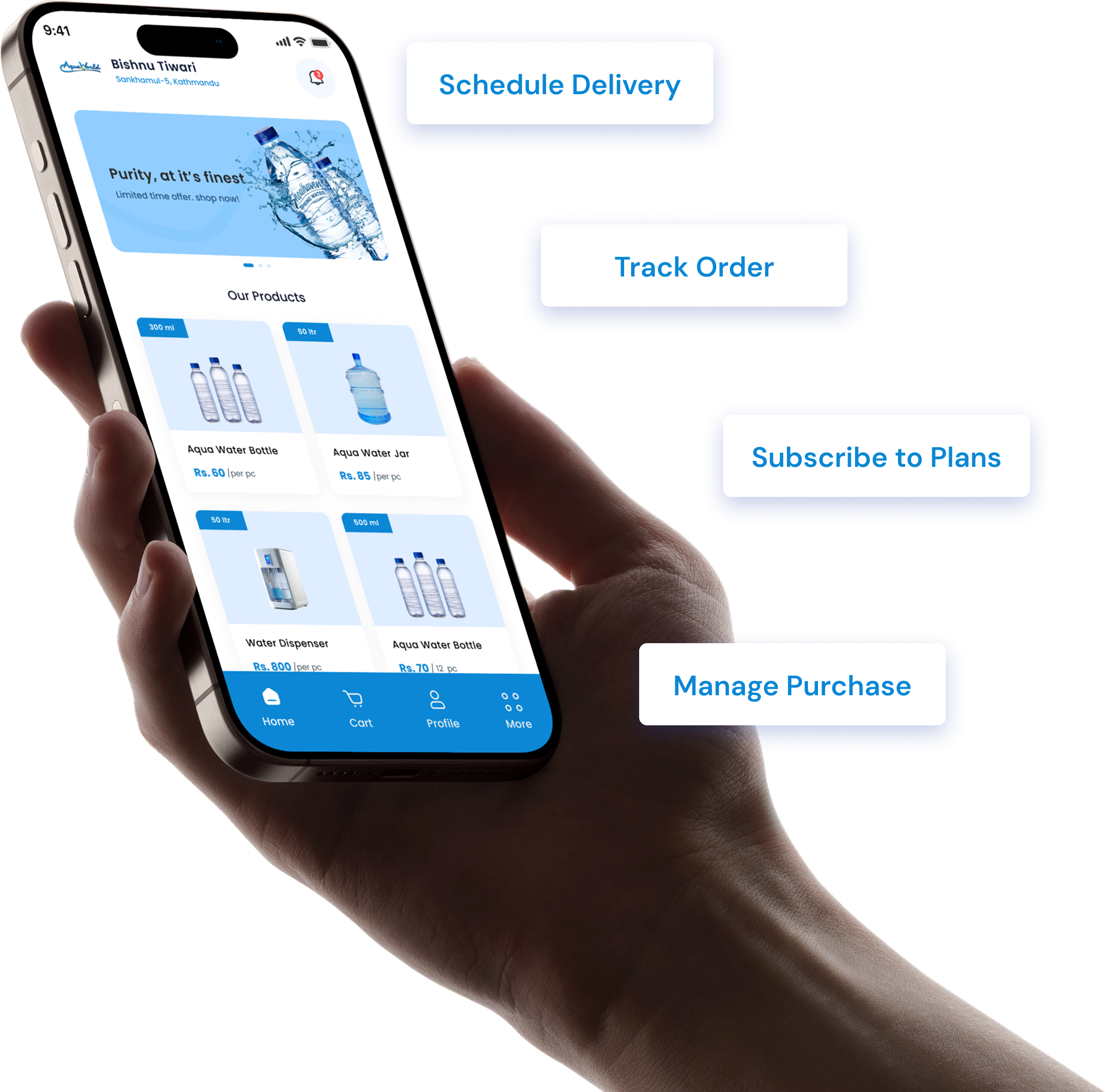
- App ordering — iOS and Android apps for easy order placement, tracking, and automatic delivery scheduling
- Web ordering — place orders at aquaworld.com.np at any time
- Phone ordering — call or WhatsApp +977-9851318038
- Delivery within 24 hours — confirmed orders are delivered the next business day (Monday–Friday, 7am–6pm)
- Minimum order — 3 jars per delivery; deposit of Rs. 300 per jar is refunded when the jar is returned
Choosing Clean Water Is Choosing Better Health
In Kathmandu Valley, where waterborne illness remains a leading cause of hospital admissions, the choice of drinking water source is a genuine health decision — not a luxury. Certified, multi-stage purified water eliminates the pathogens, heavy metals, and dissolved contaminants that make tap water unsafe for direct consumption and that basic household filters cannot fully address.
When evaluating any water supplier — including us — apply the criteria above: DFTQC licensing, ISO 22000 certification, multi-stage purification, hygienic jar handling, and documented testing. Clean water should be verifiable, not assumed.
To order Aqua World certified jar water for your home or office, visit our shop or call +977-9851318038.
Frequently Asked Questions
Q: What is the minimum order for Aqua World jar water delivery?
A: The minimum order is 3 jars (60 litres) per delivery. A refundable deposit of Rs. 300 per jar applies, which is returned in full when empty jars are collected. Delivery is available Monday through Friday, 7:00 AM to 6:00 PM, within 24 hours of order confirmation.
Q: How do I know Aqua World's water is genuinely safe?
A: Aqua World holds ISO 22000:2018 certification and is registered with Nepal's DFTQC. We conduct monthly water quality tests covering microbiological and chemical parameters, and test certificates are available on request. Our 7-stage purification process is independently audited annually as part of ISO certification maintenance.
Q: Is jar water better than buying packaged 1.5-litre bottles?
A: For regular household and office use, yes — on both cost and environmental grounds. A 20-litre jar costs Rs. 80–100 and delivers 20 litres of certified clean water. Equivalent volume in 1.5-litre bottles would cost Rs. 400–600 and generate significant single-use plastic waste. Reusable jars are also made from BPA-free polycarbonate designed for hundreds of refill cycles.
Q: What happens if I am not satisfied with the water quality?
A: Contact Aqua World immediately. We will arrange collection of the jar and provide a full replacement at no charge. Our quality guarantee covers all delivered products, and we take every quality concern seriously as it directly affects our ISO certification standing.