Kathmandu's water supply faces serious contamination challenges. Whether you rely on municipal tap water, a private tanker, or a local water source, understanding what contaminants may be present — and how to remove them — is critical for your family's health.
The Three Categories of Water Contaminants
1. Physical Contaminants
Physical contaminants affect the appearance and taste of water. In Kathmandu, these commonly include:
- Sediment and turbidity — mud, silt and rust particles from aging pipes
- Suspended solids — especially after heavy monsoon rains when surface runoff overwhelms the distribution system
- Colour and odour — caused by organic matter, algae, or pipe corrosion
Aqua World's multi-stage pre-filtration — including 5-micron and 1-micron sediment filters — removes all visible physical contaminants before purification begins.
2. Chemical Contaminants
Chemical contamination is often invisible and odourless, making it the most dangerous category. Common chemical contaminants in the Kathmandu Valley include:
- Arsenic — naturally occurring in some groundwater sources in the valley. Long-term exposure is linked to skin disease, cancer and organ damage.
- Nitrates — from agricultural runoff and septic systems, especially in peri-urban areas of Bhaktapur and Lalitpur
- Heavy metals (lead, iron, manganese) — leached from corroded pipes and industrial discharge near Bagmati tributaries
- Chlorine byproducts — residual disinfection byproducts (trihalomethanes) from KUKL treatment, which can accumulate over time
- Pesticides and herbicides — from upstream agricultural use in Nuwakot, Sindhupalchok and Kavrepalanchok districts
Aqua World's Reverse Osmosis (RO) membrane removes 95–99% of dissolved chemical contaminants, including arsenic, nitrates, heavy metals and chlorine byproducts.
3. Biological Contaminants
Biological contamination is the most immediate health risk, especially during and after monsoon. Key pathogens found in Kathmandu's water supply include:
- Bacteria — E. coli, Salmonella and Vibrio cholerae (cholera) are regularly detected in KUKL tap water samples, particularly post-earthquake infrastructure remains partially unrepaired
- Viruses — Hepatitis A and E viruses are endemic in Nepal and are transmitted through contaminated water
- Protozoa — Giardia lamblia and Cryptosporidium form hard cysts that survive standard chlorination and cause prolonged gastrointestinal illness
Aqua World's UV treatment and ozone purification destroy 99.9% of bacteria, viruses and protozoan cysts — providing a level of disinfection that boiling alone cannot match for chemical removal.
Why Boiling Isn't Enough
Boiling water kills most biological contaminants but does not remove chemical pollutants, heavy metals or physical sediment. In fact, boiling can concentrate certain dissolved solids by evaporating the water volume. For complete safety, multi-stage filtration and purification is necessary.
How Aqua World Removes All Three Types
Aqua World's 8-stage water purification process addresses physical, chemical and biological contaminants at each stage:
- Pre-sediment filter (5 micron) — removes turbidity and large particles
- Activated carbon filter — removes chlorine, organic compounds and odour
- Pre-sediment filter (1 micron) — ultra-fine particle removal
- RO membrane — removes dissolved chemicals, heavy metals and most bacteria
- Post-carbon filter — removes residual taste and odour
- UV treatment — destroys bacteria, viruses and protozoa
- Ozone treatment — additional disinfection and shelf-life extension
- Final pH balance — restores natural mineral balance
The result is water certified by DFTQC (Department of Food Technology and Quality Control) and ISO 22000:2018 certified for food safety management.
Order Safe, Purified Water in Kathmandu
Don't risk your family's health to unknown water sources. Aqua World delivers 19L purified jar water at Rs. 80/jar across Kathmandu, Lalitpur and Bhaktapur, 6 days a week. Minimum order: 3 jars.
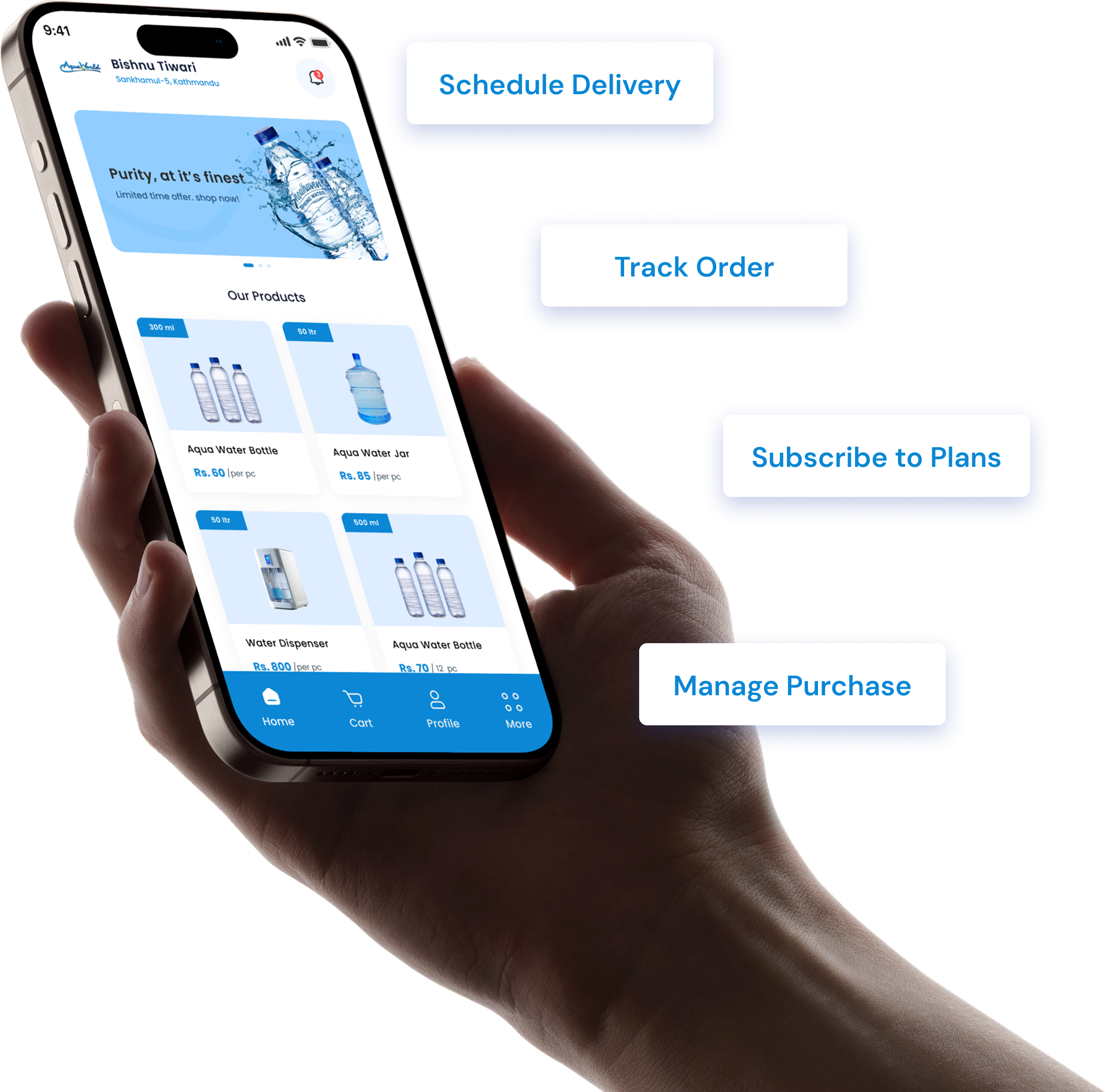
Call us at +977-15223028 or order through the Aqua World app.